History Infographics — what can they tell us about the 1940s?

History Infographics — they’re fun to look at, but what can they tell us?

After the release of the 1940 U.S. Census back in April, Ancestry.com recently shared new infographics on its blog, “Ancestry’s Infographics: What Was Life Like in 1940?” There is a graphic for the each of the 48 states, plus U.S. territories. (Alaska and Hawaii became states in 1959.) Infographics, including timelines, charts, and maps, can be great mediums to display data in eye-catching, informative ways.

Each of Ancestry’s images shows off the state’s products, such as the auto industry in Michigan or two of the 5 C’s in Arizona (cotton and citrus). Some of the graphics highlight World War II activities like the military dog training camp that opened in Montana or the Mickey Mouse-looking gas masks handed out to children after Pearl Harbor. Other pieces of trivia are just fun: where Lucille Ball and Desi Arnez were married (Greenwich, Connecticut), where the first McDonald’s opened (San Bernardino, California).

Ultimately, infographics can tell us as much about the interests of the creators as they do the subjects depicted.

As for the 1940 U.S. Census, it is full of demographic data like migration during the Great Depression and Dust Bowl, hours in a work week, and annual income. For instance, a “parcel post carrier” in Texas worked 40 hours a week, 52 weeks a year, for an income of $2,100. The 1940 census also took note of federal employment through the Works Progress Administration, Civilian Conservation Corps, and other alphabet agencies of the New Deal.

An original blank 1940 Federal Decennial Census Population Schedule

Closeup of the 1940 Population Schedule, part of the Federal Decennial Census (National Archives)

Being able to read a census form is an important skill in the researcher’s toolbox, not to mention deciphering the enumerator’s handwriting. Each decennial census (taken every 10 years) had a different look and set of information included.

Check out the 1940 U.S. Census fully indexed and searchable by name on Ancestry.com. For an introduction to the 1940 Census, the full list of questions asked by census takers (called enumerators), and a glossary of census terminology, see the National Archives website dedicated to the 1940 census.

P.S. Don’t forget to browse city directories from the time period, too, for additional information about family members and what local communities were like in the 1940s.

Digital Frontiers conference at UNT in Denton, TX

Mark your calendar! The University of North Texas in Denton, TX (home of The Portal to Texas History) is hosting the Digital Frontiers Conference and THATCamp on September 21-22, 2012. Digital history and digital humanities continue to be a trending topic at universities and libraries. As a researcher, I always want to learn more about how and why different types of records are available online in digital portals, catalogs, etc. To see examples of online historical content, check out a few of my favorite Finding Aids & Catalogs in the blogroll or on the History Resources page. Do you have a favorite not on the list? Let me know.

For more information on registration and an overview of the conference schedule, visit the Digital Frontiers website. Go to THATCamp to learn about similar digital conferences in your area. (THATCamp = The Humanities and Technology Camp)

McNitzky Printing Company 1917 calendar

North Texas State Normal College 1917 calendar, McNitzky Printing Company (Denton Public Library from The Portal to Texas History)

A Tale of Discovery

From the archives to the (web)page. Read about the “hidden” diabetic and how one study of arthritis led to a greater awareness of diabetes among Native Americans on the website The Ultimate History Project: History Matters. I’ve had the privilege to write for this photo-friendly, historical scholarship website before, but this is my first article as an official staff writer.

Out of the frying pan and into the history books

Workers Preparing Food

Two women prepare breakfast with Corn Flakes and milk for campers at Glen Lake Camp in Glen Rose, TX (Archives of the Central Texas Conference, United Methodist Church from The Portal to Texas History)

Food history — it’s a popular research subject these days. A renewed interest in locally grown food and headlines about childhood obesity have, no doubt, contributed to this trending topic.

The latest issue of the journal Public Historian highlights the range of food-related exhibits recently on display in museums and historic sites throughout the country. As the authors note, the history of what we eat and how the food gets to our table is part of many fields: cultural and social history, history of agriculture, and ecology, not to mention the history and psychology behind packaging and advertisements.

Food is such a great example of how history comes in many different formats: objects, documents, books, oral histories. Each requires a different type of analysis and, sometimes, a different search method, depending on collecting institution and online access. A quick Google search demonstrates this point.

Objects may be ordinary for their time but are unique to us today. Most often, they are displayed in physical exhibit spaces. But more often now, they also are online as digitized collections, like the old-fashioned kitchen utensils in the online exhibit “Feeding America: The Historic American Cookbook Project” from Michigan State University Library. My favorite is the Raisin Seeder. Thank goodness for seedless grapes!

Documents and pictures can come from many different creators (people, companies, organizations). Often, it is the creator’s name that is the title of the collection. For example, the National Archives’ What’s Cooking Uncle Sam? exhibit includes photos and ephemera (posters, etc.) from different government agencies that show how the U.S. agencies were involved in setting nutrition standards and growing food, particularly during wartime like the famous Victory gardens in World War II.

Books are usually the easiest to search for, if you know where to look. In my hometown of Fort Worth, TX, a browse of “food” related entries in the Cultural District Library Consortium (an online catalog of non-circulating items from some of the city’s prominent cultural institutions) gets 349 hits ranging from art and history to botany and pharmacology, books on medieval cooking and healing to a 2009 report from the United Nations on grasslands and climate change. It also includes cookbooks from the National Cowgirl Museum.

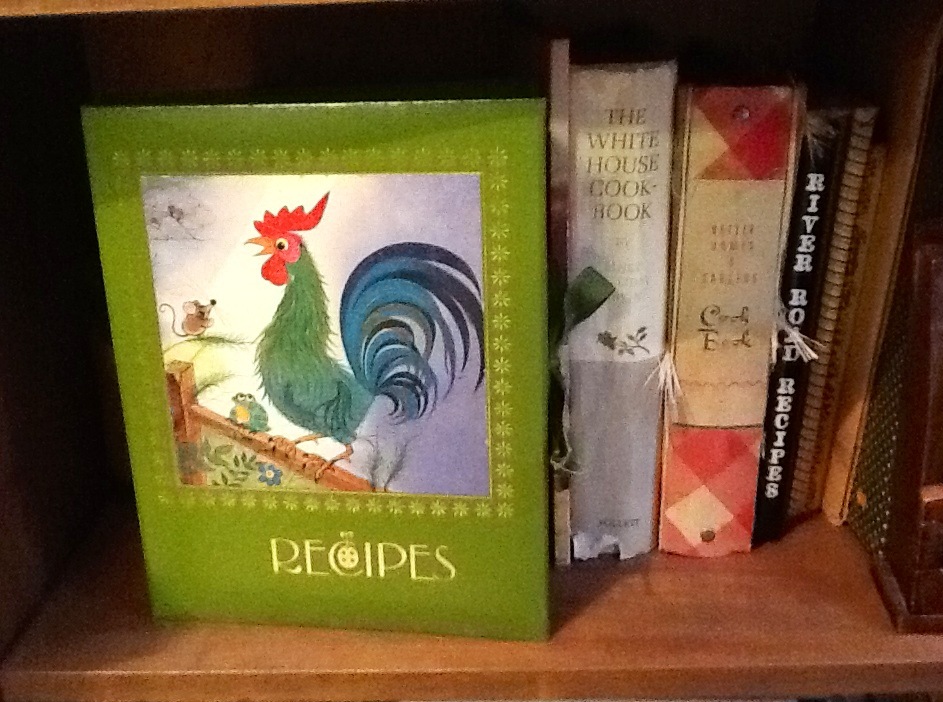
A shelf of cookbooks can tell a history, too.
Photo by author

Cookbooks also can be an important resource. The stories behind the recipes are less likely to be found in a library or archive. But they are equally valuable. They can help to tell the history of a family and a community, like the women whose recipes and interviews fill the pages of Grace & Gumption: The Cookbook, edited by Katie Sherrod (TCU Press, 2010).

Bottom line: that 3 by 5 index card of my grandmother’s famous bread pudding recipe is a historical artifact to be treasured. It also shows how recipes and their ingredients change over time… I cut the amount of sugar and eggs by half.